What Is a Symposium? Meaning, Symposium vs Seminar and Forum, and How to Host One
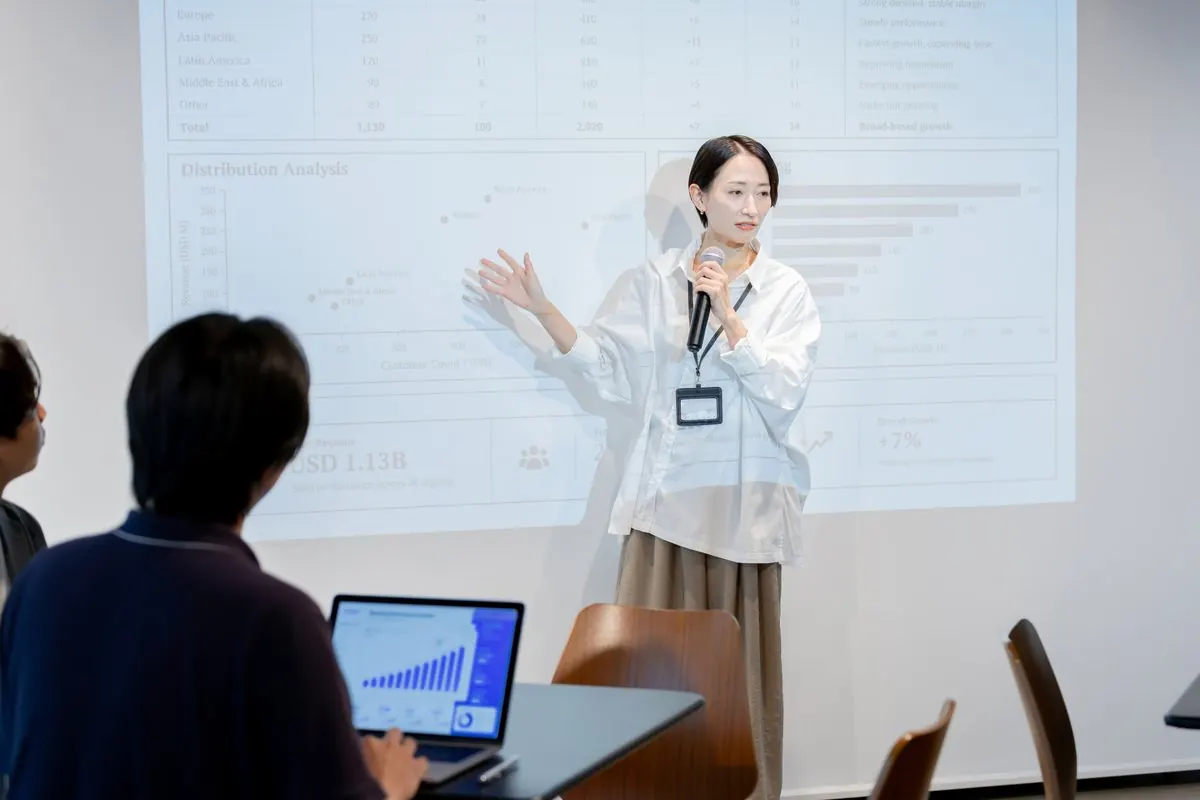
Your boss asks, “So how is a symposium different from a seminar?” and you can't quite explain it.
In one sentence, a symposium is an event where several speakers with different backgrounds each present on one theme, discuss it together, and then answer questions from the audience.
This article explains how a symposium differs from a seminar or a forum, and how to organize one.
What Is a Symposium? A Simple Definition

A symposium is an event where several speakers with different roles or areas of expertise take turns presenting their views on one theme, then discuss it with each other and answer questions from the audience. The Nihon Kokugo Daijiten, Japan's largest Japanese-language dictionary, describes it the same way: a discussion in which two or more speakers give their views on one issue from different angles, then answer questions from the audience and the chair.
Put more simply, it's an event where several experts look at the same theme from different angles. Take the theme “How will we support local healthcare in the years ahead?” A hospital doctor, a home-visit nurse and a city official each present from their own work, and at the end they answer questions from the room. Unlike a seminar, where one instructor teaches what they know, a symposium doesn't settle on one answer. It lays several viewpoints side by side so everyone can think the issue through more deeply.
The meaning and origin of the word “symposium”
The word symposium comes from the ancient Greek symposion. It originally meant “drinking together” and referred to a banquet where people talked over wine. Plato's dialogue in which a group of people talk about love is known in English as the Symposium, and its original title is Symposion. Over time, the word for conversation at a dinner party became the name for a meeting where scholars and experts gather to exchange views. Today, a symposium means an event where experts present on one theme and discuss it.
Public symposiums at universities and local governments
You may have seen the word symposium in announcements from a university or your local government. At a public symposium that a university or research institute holds for the local community, researchers explain their work in plain terms and then take questions from the audience. Local governments and industry associations hold events in the same format to discuss regional or industry challenges. In every case, several experts come together around one theme and share their thinking with the audience through presentations and discussion. Symposiums held as part of an academic conference are covered in the next section, where we compare symposiums and conferences.
Symposium vs Forum, Seminar, Lecture, Panel Discussion and Conference

Many events have names that sound like symposium, and it's hard to tell them apart from the announcement alone. Here's how they compare by number of speakers, main focus, and how the audience takes part.
| Format | Speakers | Main focus | Audience role | Typical size |
|---|---|---|---|---|
| Symposium | Several experts from different backgrounds | A presentation from each speaker, then a discussion | Ask questions in the final Q&A | Larger venues such as halls |
| Forum | Several, such as keynote speakers and panelists | Exchanging views, with the audience included | Many comments from the floor | Anything from meeting rooms to halls |
| Panel discussion | A moderator and several panelists | Discussion among the speakers | Ask questions after the discussion | Anything from meeting rooms to halls |
| Seminar | Usually one instructor | Teaching knowledge or methods | Ask questions in the Q&A | Smaller venues such as meeting rooms |
| Lecture | One speaker | Listening to the speaker | Mostly listening | Larger venues such as halls |
| Academic conference | Many researchers | Presenting and discussing research | Q&A after each presentation | Some run over several days |
Broadly, a seminar or lecture has one person speaking, while a symposium has several speakers who present from different positions and then discuss. A seminar teaches participants knowledge or skills, and a lecture is an event people attend to hear the speaker. Both have a single speaker, so you rarely see different opinions side by side. It helps to think of a symposium as an event whose value lies in exactly that: different opinions side by side.
Symposium vs forum
The word forum comes from the Latin forum, the public square at the center of an ancient Roman city. Just as citizens debated in the square, a forum is an event where the audience, not just the speakers, shares views. A symposium centers on the speakers' presentations and discussion, and the audience joins in only at the final Q&A. A forum, by contrast, is built from the start around comments from the floor.
That said, the names aren't used very strictly. Plenty of events called “[Name] Forum” are really a keynote plus a panel discussion. When you explain an event to your boss or attendees, describe who speaks and where the audience joins in, rather than relying on the name. People will get it.
Symposium vs panel discussion
A panel discussion is a format where several panelists discuss one theme, led by a moderator. The difference from a symposium is whether each speaker gives a full presentation. At a symposium, the speakers first present one by one, usually with slides, and then move on to the discussion. A panel discussion goes straight into conversation after short introductions.
The discussion in the second half of a symposium is often run as a panel discussion. In other words, a panel discussion can also be one part of a symposium. For how many panelists to invite and how to run the session on the day, see this article.
Symposium vs academic conference
An academic conference is the regular meeting where researchers in the same field, usually members of an academic society, come together to present their work. A symposium is often one session in the conference program. In the general sessions, researchers each present their own work, with a short Q&A after each talk. At a symposium, several researchers present on a theme chosen by the organizers and then discuss it, led by a chair. At a conference, you can often attend both regular presentations and a symposium on the same day.
Symposium Format: Typical Flow and a Sample Program

A symposium often runs in this order: opening remarks, a keynote, speaker presentations, a discussion, Q&A, and closing remarks. The keynote sets out the big picture, the speakers then present from their own positions, and the discussion and Q&A build on those views. A half-day (three-hour) program might look like this:
| Time | Session | Who speaks | Purpose |
|---|---|---|---|
| 1:30 pm | Opening remarks | Organizer | Share the purpose and the theme |
| 1:40 pm | Keynote (40 min) | Keynote speaker | Set out the big picture and the key questions |
| 2:20 pm | Speaker presentations (3 × 15 min) | Speakers | Speak from their own work or research |
| 3:05 pm | Break (15 min) | — | Collect and choose questions |
| 3:20 pm | Discussion (40 min) | Moderator and speakers | Dig into the differences between the presentations |
| 4:00 pm | Q&A (20 min) | Audience and speakers | Answer questions from the audience |
| 4:20 pm | Closing remarks (ends 4:30 pm) | Organizer | Thank everyone and point to the survey |
The keynote and the speaker presentations look similar but play different roles. In the keynote, one person who knows the field well explains the background to the theme and poses the questions the whole event will explore. The speaker presentations then answer those questions from each speaker's own work or research, and this is where the differences between the speakers become clear. In the discussion, the moderator picks up those differences, puts questions to the speakers, and builds on their views.
In this example, the discussion and Q&A get an hour between them. The highlight of a symposium is the discussion, where differences of opinion come out, so build the program so the discussion isn't cut even if presentations run long. If you have four or more speakers, shorten each presentation to about 10 minutes, or extend the whole event to about four hours. A large, full-day symposium sometimes runs several themed breakout sessions side by side in the afternoon, so attendees can choose the one they want to hear.
The discussion is led by a moderator, separate from the MC who runs the event as a whole. Sometimes called the chair or coordinator, the moderator links the presentations, narrows down the key points, and passes audience questions to the right speakers. If you've been asked to take on this role, read our guide to the moderator's role and tips for running the discussion.
How to Organize a Symposium: Steps and Preparation

Preparing a symposium starts with choosing the theme and securing your speakers' dates. When you invite outside experts, you can't fix the date or the venue until you know when they're available. Here's the process in seven steps.
- Decide the theme and purposeWrite in one sentence what you want attendees to take away, then choose a theme that fits.
- Choose and invite speakersMix people with different perspectives, such as researchers, practitioners and government officials. When you invite them, give the date, theme, speaking time and whether the event will be streamed, in writing.
- Book the venue and decide on streamingBook a venue that fits the number of attendees you expect, and decide whether to stream it online so people further away can join.
- Promote the event and take registrationsUse the registration form to collect questions for the speakers, and hand them over at your planning meeting.
- Hold a planning meeting with the speakersAgree on the order of presentations and speaking times, the slide deadline, and the points to take up in the discussion.
- Run the event on the dayAssign people to reception, MC, timekeeping, microphones and streaming, and make sure everyone knows how questions will be collected.
- Record it and report backKeep a recording or notes, and put them into a report together with the survey results.
What's specific to a symposium is sharing the question the whole event will explore with the keynote speaker and every other speaker in advance. Give the speakers a summary of the keynote at the planning meeting, and their presentations won't repeat it and will lead naturally into the discussion. For how to frame discussion topics and choose speakers with different perspectives, see how to plan and prepare a panel discussion.
Once your lineup is set, check the budget early. The main costs are the venue fee, speaker fees and travel, streaming equipment or a streaming vendor, and printing for flyers and programs. The more outside speakers you have, the bigger the share that goes on fees and travel, so check against your budget when you decide how many speakers to invite. That saves a scramble later.
Universities and local governments often publish a report or a recording of a public symposium on their website afterwards. It reaches people who couldn't attend and helps fill the next one, so decide early who will handle recording and notes.
Preparing to stream a symposium online
If you're streaming the symposium while also holding it in person, assign at least one person to streaming, separate from the venue team. Someone has to feed the speakers' microphones into the stream and switch between the slides and the speaker video. Also decide before the day where online viewers will send questions and who will pass them on to the room. Running in-person and online at the same time is covered in how to run a hybrid event.
How to Get More Questions in a Symposium Q&A

The bigger the venue and the audience, the fewer hands go up in a symposium Q&A. Standing up in a hall, taking the microphone and putting a question to the experts and guests on stage is intimidating, even for people who've done it before. To avoid a lively discussion followed by a silent Q&A, give people a way to ask without raising a hand.
There are three ways to do this. The first is collecting questions in advance through the registration form. The second is question cards collected during the break: attendees write their questions on paper, staff gather the cards, and the moderator reads them out during the discussion or the Q&A. The third is a Q&A tool that lets people send questions anonymously from their phones.
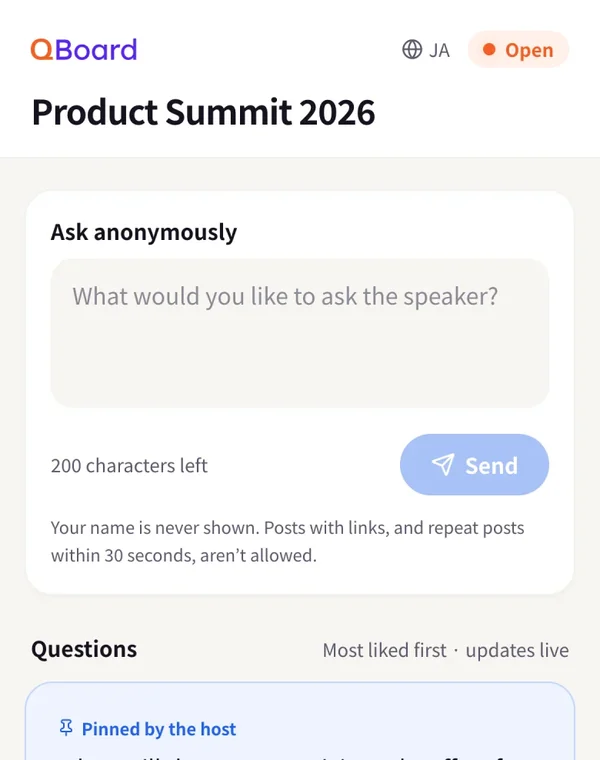
Screen: QBoard participant view
With QBoard, for example, you just put a QR code on the screen, and participants send questions from their phones without installing an app. QBoard never collects names, so not even the organizer sees who asked, and people can ask freely even when the speakers have impressive titles. One event for up to 1,000 participants costs $19, and online viewers can send questions from the same link, so even a large symposium can collect every question in one place. The screens appear in 16 languages, following each person's phone or browser language, and questions can be sent in any language. That makes it a good fit for international symposiums with speakers and attendees from abroad.
If speakers present with Google Slides, install the free Chrome extension “QBoard for Google Slides” on the presenting computer and paste the event URL on the Q&A slide. When the slideshow reaches that slide, the live question list appears on it. PowerPoint and Keynote aren't supported, so check which software each speaker will use at the planning meeting.
At a symposium, you may get more questions than you can answer in the time. If so, say in your closing remarks, “We'll answer the remaining questions in the event report,” and ask the speakers to reply afterwards. That way, no one's question goes to waste. QBoard keeps the question list viewable after the event, so you can go back to it when you write the report. For how many minutes to give the Q&A and how many questions you can answer, see this article.
What to Wear to a Symposium, and How to Listen

If you're attending a symposium and the invitation doesn't mention a dress code, business casual is enough. A jacket with a collared shirt, or a jacket or cardigan with smart trousers or a skirt, is a safe choice. At university and academic symposiums, researchers often dress much as they do day to day, so you won't stand out without a suit. If you've been invited as a speaker or guest, though, a suit is the safer choice. Halls can be cold with the air conditioning on, so bring an extra layer.
To get the most out of it, read the program and the speakers' bios beforehand. Each speaker comes from a different position, so as you listen, note who agrees with what and where views split. That makes the discussion much easier to follow. Have one question ready for the Q&A so you don't miss your chance. For how to open a question and other etiquette, see how to ask a question at a talk, with examples.
Summary: Know the Differences, Then Plan Your Symposium

A symposium is an event where several speakers with different backgrounds each present on one theme, discuss it together, and then answer questions from the audience. Several speakers presenting from different positions and then discussing is what sets it apart from a seminar, where one instructor teaches, and from a forum, which centers on comments from the audience.
If you've been asked to plan one, start by choosing a theme and a mix of speakers who'll bring different perspectives. Give people a way to ask without raising a hand, too, and you'll hear from the audience right through to the final Q&A. QBoard's free trial (up to 30 participants, 60 minutes) can be used as many times as you like, so you can run through the Q&A with your staff before the day.
Put a QR code on the screen, and both the people in the room and online viewers can send questions anonymously from their phones. Questions are sorted by likes, so the moderator can start with what the audience most wants to know.
Try it freeFree trial: up to 30 participants for 60 minutes, as many times as you like. Participants need no app and no sign-up